June 19th, 2026 at 04:48 pm
Building a professional mobile app in the UK in 2026 requires significant investment and careful planning. The average cost ranges from £40,000 to £80,000 for a robust solution, with timelines spanning 4 to 9 months from initial brief to public launch. Simple MVPs can start from £15,000 to £20,000, while complex enterprise solutions in regulated industries like Fintech can exceed £150,000 to £400,000+.
This comprehensive guide covers everything you need to know about building mobile apps in the UK, from the development process to compliance requirements, framework decisions, and post-launch maintenance. Whether you’re a startup founder, business owner, or product manager, this resource will help you navigate the mobile app development landscape with confidence.
1. The 7-Stage UK App Development Process
A professional mobile app development process in the UK follows seven distinct stages that ensure your project moves from concept to successful launch with minimal risk and maximum quality.
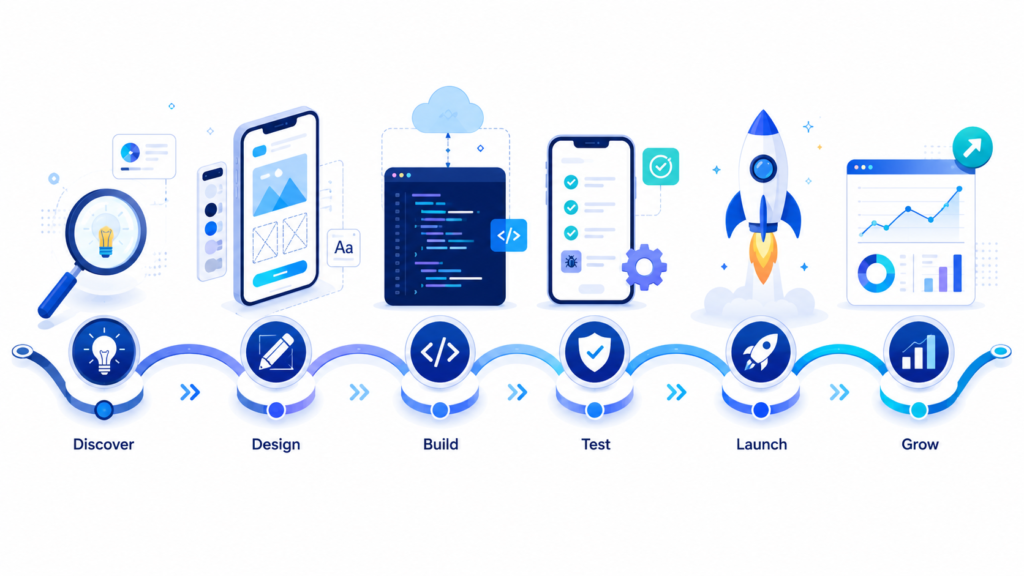
The 7-Stage UK App Development Process
Stage 1: Discovery and Strategy (2–4 weeks)
The discovery phase is where your app idea transforms into a concrete project plan. This stage involves comprehensive market research to understand your target audience, competitive landscape analysis to identify gaps in the market, and detailed requirements gathering to define what your app must do.
During discovery, you’ll develop user personas that represent your ideal customers, helping you understand their needs, behaviours, and pain points. A technical feasibility assessment ensures your concepts can actually be built within your budget and timeline constraints. Most importantly, this stage produces project scoping documents and budget planning that set realistic expectations for the entire project.
Without proper discovery, many projects fail because they build features users don’t need or underestimate technical complexity. Invest time here—it saves money later.
Stage 2: Wire framing and UX Design (3–6 weeks)
Wire framing creates the skeletal structure of your app, mapping out every user flow before visual design begins. These wireframes serve as blueprints showing how users navigate between screens, what actions they can take, and how information is organised.
UX prototyping takes 2–3 weeks and creates interactive versions of your wireframes. This allows you to test user flows, identify navigation issues, and validate design decisions before committing to development. During this phase, you’ll apply Material Design principles for Android apps or follow native UX guidelines for iOS applications.
Accessibility considerations must be integrated from the beginning, ensuring your app works for users with disabilities. This includes proper colour contrast, text sizing options, voice control compatibility, and clear navigation paths.
Stage 3: Visual Design (3–5 weeks)
Visual design executes the UI that users will actually see and interact with. This stage brings your brand into the app through colour schemes, typography, icons, and imagery that match your company identity.
The design system development creates reusable components and patterns that ensure consistency across your app. This includes buttons, cards, navigation elements, and data displays that can be used repeatedly throughout the application.
User interface refinement happens through multiple iterations based on feedback from stakeholders and potential users. The goal is to create an intuitive, visually appealing interface that users can master quickly.
Stage 4: Development Sprints (7–10 weeks minimum)
Development begins with tech stack selection. You’ll choose between native development (Swift for iOS, Kotlin for Android) or cross-platform frameworks like React Native or Flutter. This decision significantly impacts your timeline, budget, and long-term maintenance costs.
Coding happens in iterative sprints using agile methodologies. Each sprint produces working features that can be tested and reviewed. Backend integration and API development connect your app to servers, databases, and third-party services.
The logic and data layer development takes approximately 5 weeks and forms the foundation of your app’s functionality. This includes database architecture, API integration, user authentication, and business logic implementation.
Development teams work closely with designers to ensure the final product matches the intended design while maintaining performance and functionality.
Stage 5: Quality Assurance and Testing (3–6 weeks)
Testing occurs on a wide device matrix to ensure your app works across different phone models, screen sizes, and operating system versions. This comprehensive testing approach prevents issues where your app works on some devices but fails on others.
Security testing, GDPR compliance checks, and legal reviews ensure your app meets all regulatory requirements. This is especially critical for apps in regulated industries like healthcare, finance, or education.
Performance optimization identifies and resolves speed issues, memory leaks, and resource consumption problems. Bug fixes and stabilization take 2–3 weeks and are essential for creating a polished, reliable product.
Stage 6: App Store and Play Store Submission (1–2 weeks)
App Store submission (iOS) and Play Store submission (Android) require careful preparation. You’ll complete App Privacy Details in App Store Connect, providing transparent information about what data your app collects and how it’s used.
Review guideline compliance tracking ensures your app meets all platform requirements before submission. Apple and Google have strict guidelines about design, functionality, security, and content that must be followed.
Deployment preparation includes final testing, metadata optimisation, and launch planning. This stage sets the foundation for your app’s public launch and initial user acquisition.
Stage 7: Post-Launch Support (ongoing)
Post-launch support and maintenance are critical for long-term success. Your app will require ongoing updates for new operating system versions, security patches, feature additions, and bug fixes based on user feedback.
Performance monitoring tracks how your app is being used, identifying issues and opportunities for improvement. Feature updates and iterations respond to market changes and user needs, keeping your app competitive and relevant.
User feedback integration ensures your app evolves based on what your customers actually want, not just what you think they need. This continuous improvement cycle is essential for maintaining user satisfaction and retention.
A realistic timeline for professional apps is 4–9 months from initial brief to public launch. Simple apps take 3–5 months, mid-complexity apps take 5–8 months, and complex enterprise apps take 8–14 months.
2. IOS vs Android vs Cross-Platform: The 2026 Decision
For most UK startups and growth-stage companies in 2026, cross-platform development using React Native or Flutter is the right default choice for mobile apps. However, your specific needs, budget, and technical requirements may make native development more appropriate.
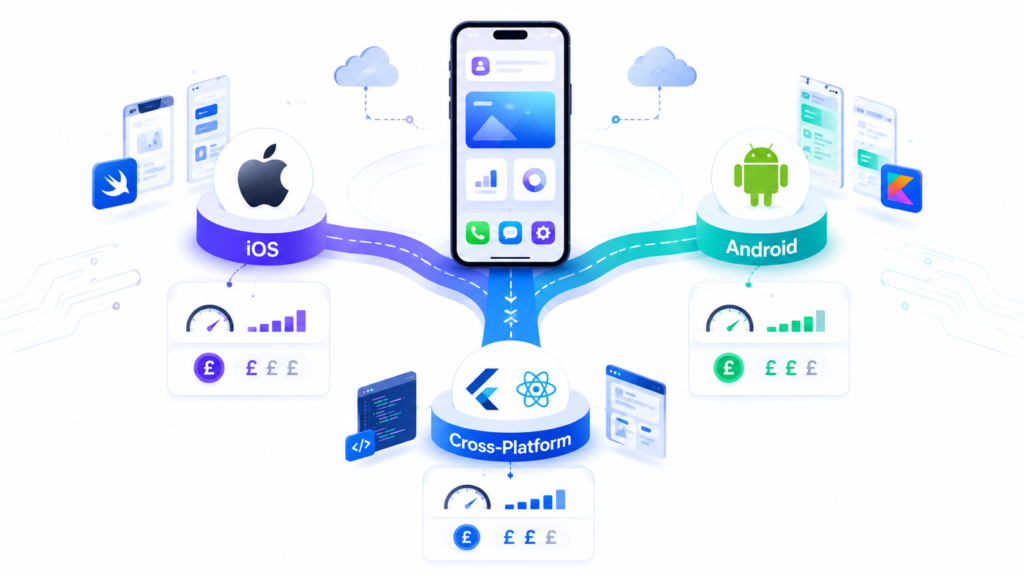
iOS vs Android vs Cross-Platform
When to Choose Native Development
Choose native development if your app requires deep platform-specific capabilities like ARKit, Core ML, HealthKit, Metal on iOS, or CameraX, Health Connect, and Vulkan on Android. Native apps provide direct access to every platform API without wrappers, enabling maximum performance for frame-rate-sensitive applications like games, real-time video processing, and augmented reality experiences.
Native development gives you first access to new platform features, as cross-platform frameworks typically lag 3–12 months behind. However, native development requires 2x development and maintenance costs since you’re building two separate codebases. You’ll need two App Store submission processes to track and must maintain business logic unless you build a shared library.
UK examples of successful native apps include Monzo, which uses native development for performance-sensitive banking UX, and NHS clinical apps requiring HealthKit integrations.
When to Choose Cross-Platform Development
Cross-platform development is ideal when you need both iOS and Android, but your budget won’t accommodate two native codebases costing £120,000 to £250,000 plus. Single codebases typically cost 60–70% of dual-native development while sharing business logic, API layers, and state management.
In 2026, React Native’s New Architecture and Flutter’s Impeller engine close the performance gap for non-frame-rate-intensive use cases. This means faster iteration with one team and one deployment pipeline. Most UK Series A–B startups, including Shopify’s merchant app, use React Native for cross-platform development.
However, cross-platform development has limitations. Not every native API has a well-maintained wrapper, cross-platform debugging can be harder since issues manifest differently on each platform, and heavy animation and GPU-intensive use cases still favour native development.
When to Choose PWA (Progressive Web App)
PWA is the right choice if your product is primarily content or information, accessed occasionally less than three times per week, with no push notifications, camera access, offline mode, or payment requirements. PWA saves 40–60% of cost compared to native development.
In 2026, PWAs can do much more than before. They support push notifications on iOS 16.4 and later, home screen installation on both iOS and Android, offline mode with Service Workers and Indexed DB, camera access, and payments via Payment Request API.
However, PWAs still cannot do background location tracking as iOS kills service workers in the background, Bluetooth on iOS Safari, NFC access, or App Store listing which eliminates your primary user acquisition channel.
Cost Comparison Over Three Years
Native dual development costs £120,000–£250,000 for initial build, with annual OS update compatibility at £8,000–£18,000, annual feature development at £25,000–£50,000, and annual maintenance at £12,000–£25,000. The three-year total ranges from £275,000 to £490,000.
Cross-platform development costs £60,000–£130,000 for initial build, with annual OS update compatibility at £4,000–£10,000, annual feature development at £15,000–£30,000, and annual maintenance at £8,000–£16,000. The three-year total ranges from £145,000 to £280,000, approximately 55% of native costs.
PWA costs £25,000–£60,000 for initial build, with annual OS update compatibility at £2,000–£5,000, annual feature development at £10,000–£22,000, and annual maintenance at £5,000–£10,000. The three-year total ranges from £62,000 to £145,000, approximately 25% of native costs.
3. How Long It Takes: Detailed Timeline by Phase
Understanding realistic timelines prevents project delays and budget overruns. Here’s a comprehensive breakdown of how long each phase takes.
Timeline Breakdown by App Complexity
Simple MVPs take 2–4 months with 3–5 months being typical. These include only core features, single-platform deployment, basic UI design, and minimal integrations with third-party services.
Mid-complexity apps take 4–8 months, with 5–9 months being typical. These include multiple screens, API integrations, custom design work, user accounts, and basic backend infrastructure.
Complex or enterprise apps take 8–12+ months, with 9–18 months being typical. These include advanced business logic, multi-platform deployment, third-party integrations, and custom backend infrastructure.
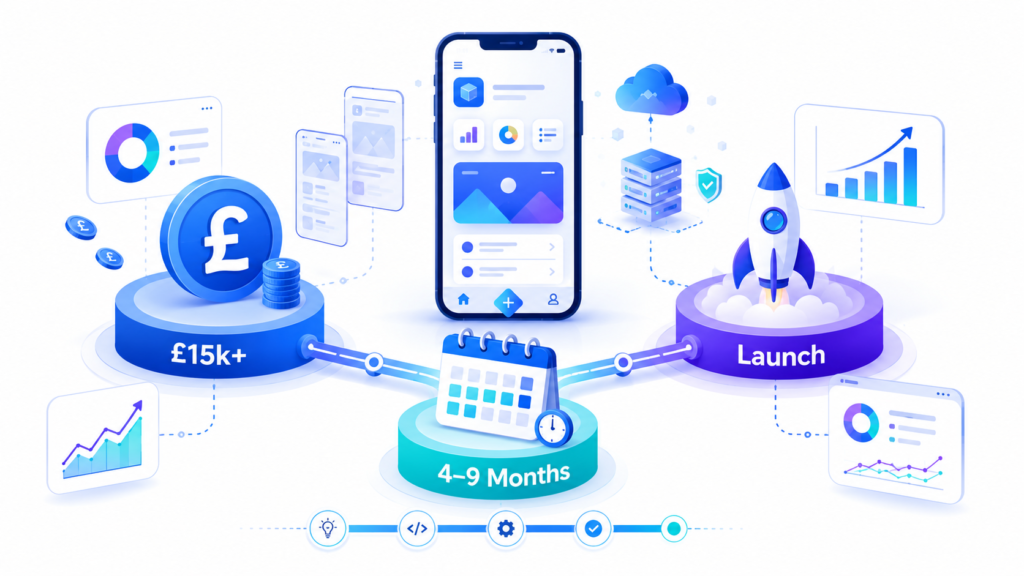
Timeline different phase in app development
Detailed Phase Timeline Breakdown
Inception and scoping take 1–2 weeks, plus 2 weeks for fact-finding, involving requirements gathering and technical feasibility assessment.
Wireframes take 1–2 weeks to create and map out user flows.
Prototyping takes 2–3 weeks for interactive prototype development that can be tested with users.
Design takes 3–5 weeks plus 3–6 weeks for UI/UX design execution, visual design work, and design system development.
Development takes 7–10 weeks plus 2–6 months for coding, backend integration, and API development. This is the longest phase and requires careful project management.
Stabilization and testing take 2–3 weeks plus 3–6 weeks for QA, bug fixes, security checks, and performance testing.
Deployment takes 1 week plus 1–2 weeks for App Store submission, launch preparation, and public release.
Post-launch support continues indefinitely for maintenance, updates, monitoring, and performance tracking.
The total professional timeline is 4–9 months from initial brief to public launch. Planning for this timeline helps ensure realistic expectations and proper resource allocation.
4. How Much It Costs in Pounds: Comprehensive Cost Table by Complexity
Budget planning is critical for successful app development. Here’s a detailed breakdown of costs by complexity level.
Basic or Simple MVP Apps
Basic apps with simple functions, single platform deployment, basic UI design, and minimal integrations cost £5,000 to £10,000. Simple MVPs can start from £15,000 to £20,000 depending on specific requirements.
Timeline for basic apps is 8–12 weeks or 3–5 months. These apps focus on core functionality only, avoiding feature creep that can inflate costs and timelines.
Intermediate or Mid-Complexity Apps
Intermediate apps with customisable UI, integrated APIs, server backend, user accounts, and multiple screens cost £10,000 to £50,000. Mid-complexity apps typically range from £65,000 to £160,000.
Timeline for intermediate apps is 5–9 months. These apps require more sophisticated architecture, better user experience design, and more comprehensive testing.
Highest-Level or Complex Enterprise Apps
Complex apps with advanced ML algorithms, security features, real-time sync, multi-platform deployment, and third-party integrations cost £50,000 to £100,000 plus. Complex enterprise apps typically range from £160,000 to £400,000 plus.
Timeline for complex apps is 9–18 months. These apps require extensive infrastructure, sophisticated security measures, and comprehensive testing across multiple platforms.
Average Cost Overview
The average cost for a robust app is £40,000 to £80,000 depending on complexity, platform choice, and compliance requirements. The total typical range spans £20,000 to £300,000 plus, reflecting differences in features, security needs, and user support requirements.
Simple MVP minimum is £15,000, while complex regulated solutions can exceed £150,000, especially in Fintech where security and compliance are paramount. Enterprise platforms can reach £400,000 plus for complex enterprise systems.
Key Cost Drivers
The biggest cost drivers are platform choice (iOS only, Android only, or both), design sophistication, required features and complexity level, security needs especially in regulated industries, and development partner expertise.
The average UK development rate is £79 per hour. If a development partner charges £79 per hour and a stage takes 600 hours, that phase costs £47,400. Add ongoing maintenance costs and feature development to get total project cost.
Platform choice significantly impacts cost. Native development for both platforms costs roughly double single-platform development. Design sophistication affects both upfront costs and long-term maintenance. Required features and complexity level determine development time and infrastructure needs.
Security needs particularly in regulated industries like healthcare and finance require additional investment in compliance, encryption, and audit trails. Development partner expertise affects both cost and quality, with more experienced teams typically commanding higher rates but delivering better results.
5. The Compliance Layer: GDPR, ICO, App Store Requirements, and Accessibility
UK mobile app compliance is critical for legal operation and user trust. Here’s everything you need to know about regulatory requirements.
GDPR Compliance Requirements
First, determine if GDPR applies to your app. If your app collects personal data from EU or UK citizens, GDPR applies regardless of where your company is located. Bring Privacy Policy and internal procedures in line with legislation requirements.
Second, obtain informed consent from users. Use click wrap method with opt-in checkbox or button that is not pre-selected. Get explicit consent from users before collecting personal data. Never assume consent or use pre-selected checkboxes.
Third, determine if extensive personal data collection is actually needed. Assess whether you need all the data you’re collecting and bring procedures in line with GDPR’s data minimisation principles.
You may need a GDPR Representative. If collecting personal data from EU or UK users, Article 27 requirements apply. Select a qualified representative based in EU and/or UK, and sign a mandate agreement authorising the representative to act on your behalf.
Complete App Privacy Details in App Store Connect including privacy policy and data processing disclosures. This is mandatory for iOS app submission.
ICO Compliance Requirements
The Information Commissioner’s Office is the UK data protection regulator overseeing GDPR compliance. The Age Appropriate Design Code applies specifically to children’s privacy and must be followed for apps used by children.
Apple and Google must comply with UK children’s privacy regulations, and app developers must ensure their apps meet these requirements as well.
App Store and Google Play Requirements
For Apple App Store, complete App Privacy Details in App Store Connect and follow Apple’s review guidelines and platform-specific requirements. Pay the £104 per year developer fee, which applies to both stores combined.
For the Google Play Store, follow Google Play review guidelines and submit through the Play Store submission process. The same £104 per year developer fee applies.
Both platforms require tracking two sets of platform review guidelines and two App Store submission processes for dual-native development. This adds complexity and cost to your project.
Accessibility Requirements
Material Design for Android includes accessibility considerations that must be implemented. Native UX guidelines for iOS also include accessibility standards that must be followed.
WCAG 2.1 AA compliance is typically required for UK apps to ensure they work for users with disabilities. The Age Appropriate Design Code applies to children’s apps, requiring additional privacy protections.
Additional UK Compliance Requirements
MHRA and DTAC requirements apply to healthcare apps regardless of whether you use native or cross-platform development. FCA Consumer Duty obligations apply to fintech apps serving UK customers.
Clinical safety requirements apply to NHS-adjacent apps, requiring additional certification and compliance documentation. These requirements significantly impact development timeline and cost.
6. How to Choose: UK Agency vs In-House vs Offshore Development
Your development partner choice significantly impacts project success, cost, and timeline. Here’s how to choose the right option for your needs.
UK Agency Development
UK agencies offer regulatory experience with healthcare, fintech, and other regulated sectors. They have documented compliance processes and familiarity with GDPR, ICO, and App Store requirements. UK-based support and communication make collaboration easier.
However, UK agencies charge higher rates around £600 to £900 per day for senior engineers, with £79 per hour being the average UK development rate. Limited availability for very large projects can be a constraint.
UK agencies are best for regulated sector apps, projects requiring UK compliance expertise, and startups needing local support and communication.
In-House Development Team
In-house development provides full control over product and timeline, direct team coordination without third-party risks, and no business logic duplication. However, dual-native development requires 2x cost for two separate teams and teams.
Hiring challenges are significant with approximately 3,500 Swift developers and 2,800 Kotlin developers in the UK market. Coordination overhead for dual-native feature development ranges from £30,000 to £80,000 per year. Two deployment tracks must be managed simultaneously.
In-house teams are best for large enterprises with dedicated resources, companies with long-term product vision, and teams with existing mobile development expertise.
Offshore Development
Offshore development offers lower costs typically 40–60% below UK rates, wider talent pool availability, and flexible scaling options. However, communication challenges include time zones and language differences.
Potentially less regulatory experience means offshore teams may not understand UK compliance requirements. Quality control may require additional oversight and management. GDPR compliance may be more complex to manage with offshore teams.
Offshore development is best for budget-constrained projects, MVP development, and non-regulated applications where compliance expertise is less critical.
Recommendation for Most UK Companies
For most UK startups and growth-stage companies, cross-platform development with a UK agency is the optimal choice. Choose a development partner with sector experience and documented compliance process, not just framework optimisation expertise.
The key consideration is finding a partner who understands your industry’s regulatory requirements and can navigate UK compliance landscape effectively.
7. Post-Launch: ASO, Maintenance, and R&D Tax Credits
Post-launch activities are critical for long-term success and should be planned from the beginning of your project.
App Store Optimization (ASO)
ASO involves optimising app title, description, and keywords for search visibility. Create compelling app screenshots and preview videos that showcase your app’s features. Manage user reviews and ratings to build trust with potential users.
Update your app regularly to maintain visibility in store rankings. Monitor analytics and adjust your ASO strategy based on performance data and user behaviour.
Maintenance Requirements
Annual maintenance costs include OS update compatibility at £4,000 to £18,000, bug fixes at £5,000 to £25,000 ongoing, feature development at £10,000 to £50,000 per major feature, and general annual maintenance at £8,000 to £16,000 for cross-platform apps.
Post-launch support continues indefinitely for maintenance, updates, monitoring, and performance tracking. This ongoing investment is essential for maintaining app quality and user satisfaction.
R&D Tax Credits for UK App Development
UK companies can claim 20% above-the-line RDEC on qualifying R&D spend through the merged R&D Tax Relief scheme that applies to software development. Enhanced R&D Intensive Support offers 14.5% cash credit worth up to 27p per £1 of qualifying spend for loss-making R&D-intensive SMEs where qualifying R&D is 30% or more of total expenditure.
Project must seek advance in science or technology field to qualify. Only companies chargeable to UK Corporation Tax can qualify for R&D relief. Software development may be eligible for R&D tax relief if it meets innovation criteria.
Check eligibility through HMRC guidance and document qualifying R&D activities and expenditures. Include R&D claims in your Corporation Tax return.
Additional Post-Launch Activities
Monitor user feedback and analytics to identify issues and opportunities. Track performance metrics and bug reports to maintain app quality. Plan and implement feature updates based on user needs and market changes.
Maintain security compliance including GDPR updates as regulations change. Manage App Store and Play Store reviews professionally. Coordinate with marketing for user acquisition and retention strategies.
FAQ
What is the average cost to build a mobile app in the UK in 2026?
The average cost ranges from £40,000 to £80,000 for a robust mobile app, depending on complexity, platform, and compliance requirements. Simple MVPs start from £15,000 to £20,000, while complex enterprise solutions can exceed £150,000 to £400,000 plus.
How long does it take to build a mobile app in the UK?
A realistic timeline is 4–9 months from initial brief to public launch for professional apps. Simple apps take 3–5 months, mid-complexity apps take 5–8 months, and complex enterprise apps take 8–14 months.
Which framework should I choose: iOS, Android, or cross-platform?
For most UK startups in 2026, cross-platform using React Native or Flutter is the right default. Choose native only if you need deep platform-specific capabilities like ARKit, HealthKit, or 60fps graphics. Choose PWA for content-only, low-frequency apps.
What GDPR compliance is required for UK mobile apps?
You must determine if GDPR applies when collecting EU or UK personal data, obtain informed consent via opt-in checkbox, complete App Privacy Details in App Store Connect, and consider needing a GDPR representative if collecting from EU or UK users.
Can I claim R&D Tax Credits for mobile app development?
Yes, software development may qualify for R&D tax relief if the project seeks an advance in science or technology. UK companies can claim 20% RDEC on qualifying spend, or 14.5% cash credit for loss-making R&D-intensive SMEs.
What’s the difference between native, cross-platform, and PWA?
Native development creates separate apps for iOS using Swift and Android using Kotlin with full platform API access. Cross-platform uses single codebase with React Native or Flutter serving both platforms at 60–70% of dual-native cost. PWA is web-based app accessible via browser, 40–60% cheaper but without App Store listing.
How much does maintenance cost after launch?
Annual maintenance ranges from £8,000 to £25,000 depending on complexity, including OS updates at £4,000 to £18,000, bug fixes at £5,000 to £25,000, and feature development at £10,000 to £50,000 per major feature.
Should I choose a UK agency, in-house team, or offshore developers?
For most UK startups, cross-platform development with a UK agency is optimal. Choose based on sector experience and documented compliance process, not just framework optimisation expertise.
Building a mobile app in the UK in 2026 requires more than just a great idea—it demands strategic planning, the right technology choices, realistic budgeting, and a clear understanding of compliance requirements. From discovery and UX design to development, testing, launch, and ongoing maintenance, every stage plays a critical role in delivering a successful product.
For most UK businesses, cross-platform development with React Native or Flutter offers the best balance of cost, speed, and scalability. However, your ideal approach should align with your business goals, user needs, compliance obligations, and long-term growth plans.
Whether you’re launching a startup MVP, developing a customer-facing application, or building a complex enterprise platform, investing in the right development partner can significantly reduce risk and accelerate time to market. By understanding the development process, timelines, costs, and regulatory requirements outlined in this guide, you’ll be better equipped to make informed decisions and turn your app idea into a successful digital product.
If you’re planning to build a mobile app in the UK, start with a clear strategy, focus on user experience, and choose a development team with proven expertise in delivering high-quality, scalable mobile solutions. The right foundation today can help your app grow and succeed for years to come.