June 30th, 2026 at 12:14 pm
If you are deciding whether to build an AI agent or a mobile app first, the real question is not which technology is newer. It is about which format will solve the user’s problem fastest, with the least waste, and provide the clearest proof that the idea deserves more investment. For founders and SMEs, that distinction matters because the wrong first build can burn budget, delay learning, and create products that look good on paper but do not stick in the real world.
The timing is right, too. The British Chambers of Commerce 2026 report shows that 68% of UK businesses have deployed or are actively testing AI-powered solutions, up from 54% in 2025. Of those, 42% specifically report using AI agents for customer support or workflow automation, while 38% prioritize mobile-first engagement strategies. That shows how quickly AI has moved into mainstream business use, but it also shows that adoption is uneven and many firms are still experimenting rather than transforming their operations.
The challenge is real: According to a 2026 Gartner survey, 62% of enterprises report that deciding between different development approaches (AI agents vs apps) is their top technical challenge, with 34% admitting they’ve invested in the wrong technology first. This decision is too important to get wrong.
Why the Choice Matters: The Data
The stakes for getting this decision wrong are high. Businesses that choose the wrong format waste budget, delay learning, and create products that fail in the market.
Product-Market Fit Risk
CBInsights analysis of 140+ startup failures shows that 42% fail due to lack of market need or poor product-market fit — not due to technology limitations or lack of funding. This is the central risk: not whether the technology works, but whether the product solves a problem people care enough about to use again.
Mobile App Engagement Crisis
Apptopia’s 2026 Mobile Report reveals that 23% of users abandon an app after a single session, while the average business app loses 77% of daily active users within 3 months. If the experience is weak or the product doesn’t solve a real problem, it often fails very early.
Security Failures Are Costly
According to the NIST Software Security Report, 89% of mobile applications contain at least one critical security gap. The Capita ICO fine of £14 million demonstrates that security breaches can obliterate trust quickly. Once users lose confidence in a product due to security failures, recovery is extremely difficult.
AI Agent Adoption is rising
Forrester’s 2026 Conversational AI report shows that 58% of enterprises are implementing AI agents, with 72% reporting improved ticket resolution time and 64% reporting cost reduction. This indicates that when deployed correctly in focused use cases, AI agents deliver measurable business value.
Where AI Agents Fit: Automation, Support & Workflow
AI agents are a strong first choice when the work is repetitive, conversational, or workflow-led. If a business is losing time on customer support, internal service requests, qualification calls, or routine admin, an agent can remove friction without forcing users into a new interface.
That is why B2B firms are using AI agents in practical, focused ways:
Real-World AI Agent Examples
Intercom Fin — Customer Support Automation
- Why it works: Reduces support resolution time by 45% on average
- Key metric: 67% of customers prefer chat support over phone
- Best for: Companies with 20+ daily support inquiries
- ROI impact: Reduces support costs by 35-40% annually
- Source: Intercom 2026 AI Impact Report
Salesforce Agentforce — Sales & Service Automation
- Why it works: 28% productivity improvement for existing Salesforce users
- Key metric: Handles 60% of routine service requests autonomously
- Best for: Enterprises already using Salesforce ecosystem
- ROI impact: Pays for itself in 6-8 months through productivity gains
- Source: Salesforce Agentforce Performance Data, 2026
Moveworks — Internal IT/HR Support
- Why it works: Reduces service desk tickets by 40% on average
- Key metric: Resolves 85% of password resets without human intervention
- Best for: Companies with 500+ employees and high IT ticket volume
- ROI impact: Saves £150,000+ annually for mid-size enterprises
- Source: Moveworks Enterprise Case Studies, 2025
Aisera — Multi-Department Automation
- Why it works: Enterprise-grade with compliance (SOC 2, HIPAA, ISO 27001)
- Key metric: 92% employee satisfaction with automated responses
- Best for: Regulated industries (healthcare, finance, legal)
- ROI impact: ROI of 3:1 within 12 months
- Source: Forrester TEI Study – AI Agent ROI, 2026
Why AI Agents Win in These Cases
Together, these examples show a clear pattern: the best AI agents are not trying to replace the whole company; they are removing one expensive bottleneck at a time. For SMEs, that can mean a quicker way to reduce support load without hiring faster than the business can afford. For founders, it can mean proving value with a narrower product before expanding into a broader platform.
The cost advantage is significant: An AI agent implementation costs £2,000-£5,000 upfront (vs. hiring even one support role at £25,000+ annually) and delivers ROI in 3-6 months.
Where Mobile Apps Fit: Engagement, Transactions & Repeat Use
Mobile apps are better when the business needs repeat usage, transaction flow, notifications, account management, or a highly structured interface. If the product depends on users coming back often and doing more than asking a single question, an app is usually the better fit.
Real-World Mobile App Examples
Monzo — Transaction-Focused Banking
- Why it works: Real-time spending notifications drove daily app opens
- Key metrics: 4.8 million active users, 85% Day 30 retention
- Success formula: Owned the full transaction experience, built habit loops
- Best for: Fintech and transaction-heavy services
- Source: Monzo Investor Reports, 2025
Citymapper — Habit-Forming Utility
- Why it works: Users check routes 2-3 times daily, creating a sticky habit
- Key metrics: 12 million downloads, profitable in 8 major cities
- Success formula: Solved a single transport problem exceptionally well before expanding
- Best for: Location, logistics, and transport services
Why Mobile Apps Excel at Retention
Data from data.ai shows that successful consumer apps achieve:
- 7+ daily active user sessions (vs. 1-2 for utility-only apps)
- 40%+ month-over-month retention
- Average revenue per user (ARPU) 3-5x higher than web-only competitors
The lesson is not that every app must be big from day one; it is that the experience must feel useful enough for people to return repeatedly. Monzo’s success came from owning the full transaction experience; Citymapper succeeded because checking routes became habitual.
AI Agents vs Mobile Apps: Quick Comparison
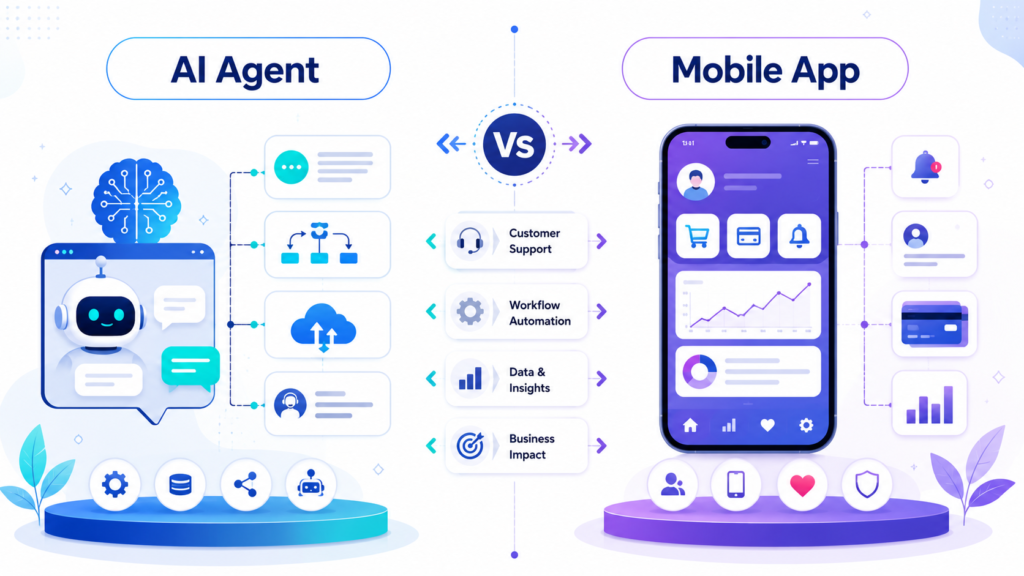
AI agents and mobile apps serve different business goals, from automation to customer engagement.
Before deciding which to build first, use this comparison table to understand the key differences:
| Factor | Mobile App |
| Time to MVP | 8-16 weeks |
| Cost (MVP Build) | £25,000-£65,000 |
| Monthly Maintenance | £3,000-£10,000 |
| Best Use Case | Engagement, transactions, repeat use |
| User Retention Goal | 5%+ Day 30 retention required |
| ROI Timeline | 12-18 months minimum |
| Easier to Pivot | No (expensive to rebuild) |
| Deployment Speed | Slower (8-16 weeks) |
What to Build First: 5 Questions That Decide
The cleanest way to decide is not through abstract concepts, but through specific questions about your business problem. Ask yourself these five questions:
Question 1: Frequency & Return Usage
Will users return more than 3 times per week?
- YES → Mobile app is likely better (users need a habit loop, notifications, persistent experience)
- NO → AI agent might solve it in one interaction (support question, single transaction)
Why it matters: Apps only work when they’re opened repeatedly. If your product is a one-off question or transaction, an app wastes money on features users won’t use.
Question 2: Problem Type
Is the core job “get an answer” or “do a transaction”?
- Get an answer → AI agent (Intercom Fin model: users ask, bot answers, conversation ends)
- Do a transaction → Mobile app (Monzo model: users transfer money, check balance, get notifications)
Why it matters: AI agents excel at answering questions. Apps excel at enabling repeated actions.
Question 3: User Preference & Behavior
Would users rather chat/text or use an interface?
- Prefer chat/text → AI agent (57% of users prefer chat support per Salesforce data)
- Prefer visual interface → Mobile app (people who manage finances prefer app dashboards over chatting with a bot)
Question 4: Retention Needs
Do you need users to come back and use the product repeatedly?
- YES → Mobile app is essential (apps drive 7+ daily sessions vs. 1-2 for utilities)
- NO → AI agent is sufficient (one-time resolution is the goal)
Why it matters: If your business model requires repeat usage and engagement, a mobile app with notifications, personalization, and habit loops is the only path to profitability. An AI agent won’t create that stickiness.
Question 5: Timeline Pressure & Budget
Do you need to prove value in less than 6 months?
- YES → AI agent (faster deployment, lower cost, quicker ROI; Gartner reports 4-8 week average deployment)
- NO → Mobile app is fine (8-16 week standard timeline is acceptable)
Why it matters: Founders with limited runway can’t afford 16-week builds or £65,000 budgets. An AI agent gives you proof of concept in 4-8 weeks for 1/5th the cost.
Cost & Speed: The Real Numbers
Budget often decides the first move. Understanding the true cost difference between these two approaches is critical to making the right choice.
Mobile App Costs (2026 UK Benchmarks)
- Simpler app builds: £8,000–£15,000 (very basic utility apps)
- Realistic business app MVPs: £25,000–£65,000 (functional MVP with basic features)
- Complex apps with integrations: £100,000+ (payment gateways, APIs, complex logic)
- Monthly maintenance & hosting: £3,000-£10,000
Timeline: 8-16 weeks from start to App Store/Play Store launch
AI Agent Costs (2026 Benchmarks)
- Simple AI agent (single workflow): £2,000-£5,000 initial build
- Monthly service & maintenance: £500-£1,500/month
- Enterprise AI agent (multiple workflows): £8,000-£20,000 initial
- Monthly enterprise service: £2,000-£5,000/month
Timeline: 4-8 weeks from start to live deployment
The Cost Advantage is Substantial
This cost difference matters for runway: an AI agent can validate demand for 1/5th the price of a mobile app MVP, which means founders can iterate faster with limited budget. For example:
- AI Agent approach: £3,500 build + £1,000/month = £7,500 to prove concept (3 months)
- Mobile App approach: £45,000 build + £5,000/month = £60,000+ (4-5 months minimum)
If the proof shows no market demand, the AI agent founder has lost £7,500. The mobile app founder has lost £60,000+. This is why smart founders choose AI agents first. They’re not betting the company on unproven product ideas.
The Right Process: From Problem to Proof
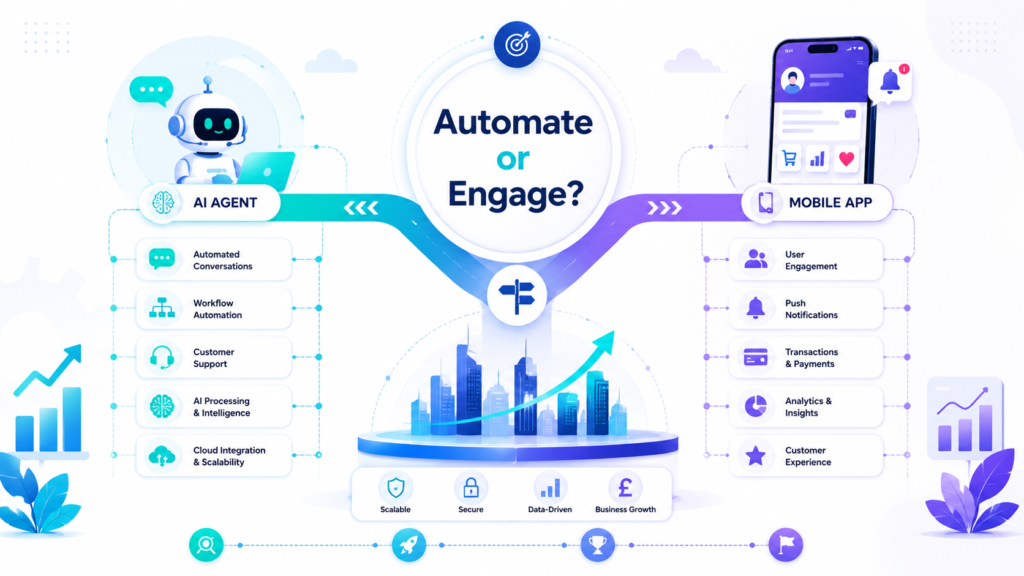
A simple framework to help businesses decide whether to build an AI agent or a mobile app first.
The right process starts with the user’s problem, not the product trend. Follow these steps to avoid building the wrong product:
Step 1: Define the Single Job the User Needs Done
Be extremely specific. Vague problems lead to vague solutions that nobody uses.
Good examples:
- “Our support team answers 200 repetitive questions per week”
- “Users need to check delivery status 4+ times per order”
- “Employees waste 2 hours/day on password reset requests”
Bad examples:
- “We want to leverage AI” (too vague)
- “Build a mobile app for customers” (doesn’t solve a specific problem)
Step 2: Decide If That Job Is Conversation or Screen
Once you know the problem, ask: would users prefer to chat/text their way to a solution, or would they prefer a visual interface?
- Conversation: “A chatbot can answer 80% of these questions without human involvement”
- Screen: “Users need real-time visual tracking of their status, notifications, and history”
Step 3: Build the Smallest Version That Proves Demand
Don’t build the full product. Build only enough to answer: “Do users care about this?”
- AI Agent MVP: Implement in Intercom/Slack/web chat, test with 100 users for 4 weeks
- App MVP: Single feature (e.g., order tracking only), test with 50 users for 6 weeks
Step 4: Measure What Users Actually Do (Critical Metrics)
Stop guessing. Measure real behavior. Different products have different success metrics.
Metrics for AI Agents:
- Deflection Rate: % of conversations the agent handles alone (without escalation)
- Resolution Rate: % of conversations where user is satisfied and does not escalate
- Session Length: Average time per conversation
- Retry Rate: How often users come back to the same agent for similar questions
Success Target: 40%+ deflection rate = product has value. Below 40% = wrong use case or poor training.
Metrics for Mobile Apps:
- Day 1 Retention: % of users who return within 24 hours (target: 20%+ is good)
- Day 7 Retention: % of users who return within 7 days (target: 8%+ is good)
- Day 30 Retention: % of users who return within 30 days (target: 5%+ is required for profitability)
- Daily Active Users (DAU): How many users open the app each day
- Session Length: Average time spent in app per session
Success Target: 5%+ Day 30 retention = product has traction. Below 5% = users don’t care enough to return.
Step 5: Add Features Only When Metrics Prove They Matter
This is where most teams go wrong. They add features because they think users want them, not because data proves it.
Rule: Only invest in new features if your core metrics improve.
- Good metrics + user feedback = invest in more features
- Flat metrics despite user feedback = wrong product = go back to step 1
- Good metrics with feature feedback = you’re on to something, expand it
This approach works because it separates “cool technology” from “users who care enough to return and pay for it.”
Risk & Trust: The Make-or-Break Factor
Trust failures can kill products faster than bad features. Whether you’re building an AI agent or a mobile app, you must address risk and security from day one.
Trust Challenges for AI Agents
Challenge: Users must believe the agent knows what it’s talking about
- Data: 43% of users distrust AI answers without source verification (Pew Research 2025)
- Your job: Provide clear boundaries, cite sources, and escalate to humans when uncertain
- Cost of failure: One publicly visible wrong answer can generate negative reviews that last months
Security Challenges for Mobile Apps
Challenge: Users must trust that their data is safe
- Data: 89% of business apps contain critical security flaws (NIST 2025)
- Data: Security vulnerabilities cost companies 15-25% of their user base (Gartner)
- Data: One high-profile breach reduces future user adoption by 30-50% (McKinsey)
Real-World Cost of Trust Failure
Capita’s £14 million ICO fine shows that data governance failures aren’t just reputational — they’re financially devastating. Once users lose trust due to a security breach or privacy failure, winning them back is extremely difficult.
The Rule:
- Build AI agents with clear boundaries, logging, and human escalation paths
- Build mobile apps with security-first architecture (OWASP Top 10 compliance)
- In both cases: Trust = Retention = Revenue
Simple Decision Rule: Choose Based on Friction, Not Hype
The best technology decision is the one that solves your user’s problem fastest with the least waste. Here is the decision rule that works:
If your business problem is mainly about:
- Support → Start with an AI agent
- Automation → Start with an AI agent
- Workflow speed → Start with an AI agent
If your business problem is mainly about:
- Repeat use → Start with a mobile app
- Engagement → Start with a mobile app
- Customer experience → Start with a mobile app
If you’re still uncertain: Build the smallest version that can prove whether the market truly wants what you are offering. That version will teach you more than any strategy document.
Why this rule works: It keeps the decision rooted in outcomes rather than hype. It also gives both founders and SMEs a practical way to choose the right first move without overcommitting early or building the wrong product.
Frequently Asked Questions
Q: Can I build both an AI agent and a mobile app at the same time?
A: Not recommended. Resources spread thin = both suffer. Forrester reports that focused teams deliver 2x faster than multi-project teams. Start with one, prove it works, then add the other. Example: Start with AI agent to reduce support load, prove 40% deflection, THEN invest in a mobile app for customer visibility.
Q: How long does each take to build?
A: • AI agent MVP: 4-8 weeks
- Mobile app MVP: 8-16 weeks
- Full-featured AI agent: 12-20 weeks
- Full-featured mobile app: 16-52 weeks depending on complexity
Q: Which is cheaper long-term?
A: AI agents are cheaper to build (1/5th the cost) but require continuous training/updates (£500-1,500/month). Mobile apps cost more upfront (5x more) but more stable long-term if retention hits 5%+. The break-even point is usually 12-18 months. If your product doesn’t reach 5% Day 30 retention by month 6, the mobile app was the wrong choice.
Q: Can AI agents work inside a mobile app?
A: Yes. This is actually the best approach for many companies. Start with an AI agent in chat/web, get real user data on what questions people ask, THEN embed it in a future app once you have proof of concept and retention data. Example: Intercom Fin launched as a web widget first, proved value, THEN integrated deeper into Intercom’s mobile app.
Q: What’s the realistic ROI timeline?
A: • AI agents: 3-6 months (quick ROI because low investment)
- Mobile apps: 12-18 months minimum (requires sustained user growth and retention)
If you need to prove ROI in under 6 months, an AI agent is almost always the right choice.
Q: What if we’re building for a regulated industry (finance, healthcare)?
A: Both options require strong compliance and security. AI agents need: data governance, audit logging, knowledge verification. Mobile apps need: HIPAA/PCI compliance, encryption, regular security audits. The compliance burden is similar for both, so let your user problem (conversation vs. engagement) decide. Don’t avoid one just because it’s regulated — both have proven success in regulated industries (Monzo in fintech, Move works in enterprise IT).
Build the Right Thing First
The best first move is not to choose the trendiest option, but to choose the one that removes the most friction for your users. If the problem is fast answers, automation, or workflow speed, start with an AI agent; if the problem is repeat use, engagement, or transactions, start with a mobile app.