September 15th, 2026 at 08:52 am
Last updated: September 2026
Author: Ronak Shah, Nordstone — app development consultancy
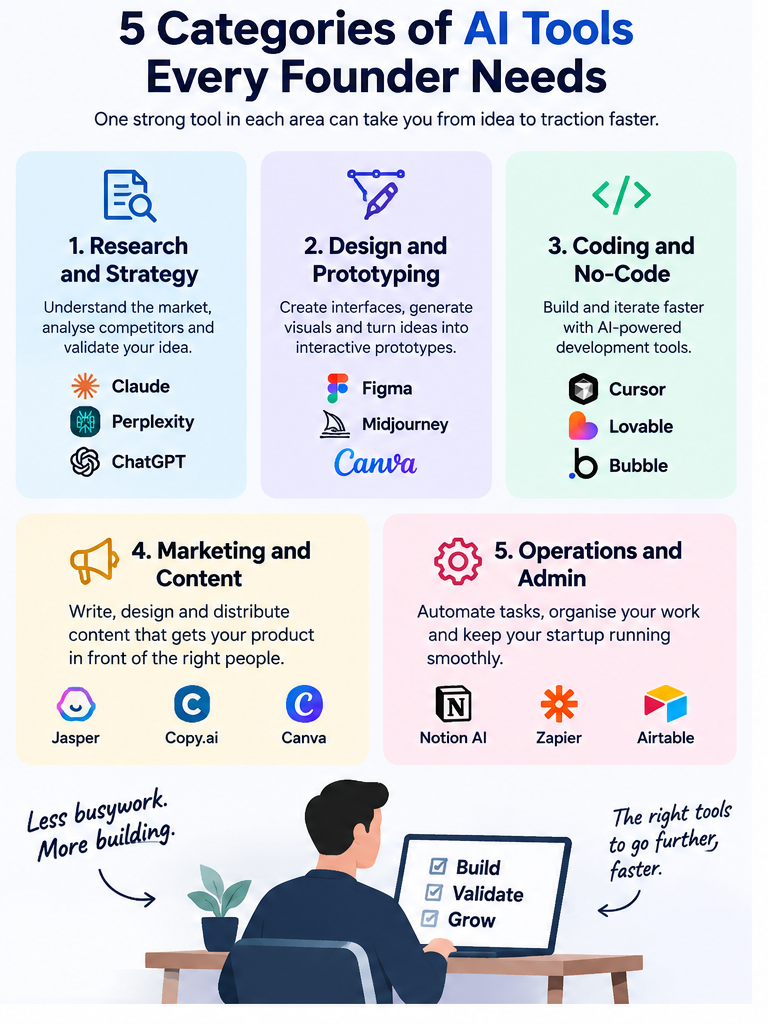
Founders benefit most from five categories of AI tool: research and strategy, design and prototyping, coding and no-code, marketing and content, and operations and admin. The best current picks are Claude or Perplexity for research, Figma AI or Midjourney for design, Cursor or Lovable for building, Jasper for content, and Notion AI or Zapier for admin — chosen for depth in one job rather than doing everything passably.
TL;DR
- Categories that matter: research/strategy, design/prototyping, coding/no-code, marketing/content, operations/admin — most founders need at least one tool in each.
- Top picks per category: Claude/Perplexity (research), Figma AI/Midjourney (design), Cursor/Lovable (build), Jasper/Copy.ai (content), Notion AI/Zapier (ops).
- No-code has matured fast: the low-code/no-code market is projected to pass $44 billion in 2026, and a quarter of Y Combinator’s Winter 2025 batch had codebases that were 95% AI-generated.
- How to choose: prioritise tools with genuine code/data export over ones that lock your work into their platform permanently.
- What to avoid: tools with no free trial, vague data-use terms, or heavy marketing but thin production track record — test with your actual workflow before paying.
Which AI tools actually help founders?
Most founders don’t need fifteen AI subscriptions — they need one strong tool in each of the jobs a startup actually does: understanding the market, shaping the product, building it, telling people about it, and keeping the business running day to day. The mistake many founders make is chasing whatever tool is trending that week rather than picking deliberately by category. A general-purpose assistant like Claude or ChatGPT covers a lot of ground, but pairing it with one specialist tool per category — a coding assistant, a design tool, a research tool — consistently outperforms trying to force one tool to do every job adequately. The sections below cover the five categories worth having a considered pick in, not just a default.
AI for research and strategy
For market research, competitive analysis and fact-checking, Perplexity is a strong default because it returns sourced, citable answers rather than an unverifiable summary — genuinely useful when you need to back up a claim in a pitch deck or investor update. For general reasoning, drafting and analysis — thinking through a pricing model, stress-testing a go-to-market plan, or summarising a long document — Claude and ChatGPT remain the most versatile tools available, with Claude particularly strong on long documents and structured analytical work. Neither replaces your own judgement on strategy, but both meaningfully speed up the thinking-and-drafting loop that used to take a founder — or a hired analyst — days.
AI for design and prototyping
For interface and product design work, Figma’s AI features now assist directly inside the design tool most product teams already use, generating layout variations and assets without leaving the file. For image generation — pitch deck visuals, marketing imagery, or product mockup backgrounds — Midjourney remains a leading choice for photorealistic, brand-quality output, with paid plans starting from around $10 a month for a modest amount of generation time. For founders without any design background at all, Canva’s AI tools offer the lowest-friction route to professional-looking marketing assets, social graphics and simple presentations. None of these replace a skilled product designer for a polished, differentiated brand — but for early-stage visual work, they close the gap dramatically.
AI for coding and no-code
This category has moved fastest of the five. AI-native code editors like Cursor assist experienced developers directly inside a real codebase, and prompt-to-app builders like Lovable, v0 and Bolt can now generate a working web app — frontend, backend logic and database — from a plain-language description. That shift is best illustrated by a specific, attributed data point: in March 2025, YC managing partner Jared Friedman said a quarter of the accelerator’s Winter 2025 batch had codebases that were 95% AI-generated, a figure YC CEO Garry Tan later confirmed publicly, adding that these were highly technical founders who a year earlier would have built the same product entirely by hand. For founders who want a fully visual, no-code platform rather than AI-generated code, Bubble remains the most battle-tested option, handling frontend, backend, database and hosting in one place, with a free plan and paid tiers from around $29 a month. The overall no-code and low-code market is projected by Gartner to reach roughly $44.5 billion in 2026, growing at about 19% a year — reflecting how mainstream this route to a first product has become, though it’s worth reading the section below on lock-in before committing your core product to any single platform.
AI for marketing and content
For drafting marketing copy, ad variations and long-form content at speed, tools like Jasper and Copy.ai remain widely used starting points, particularly for founders without an in-house copywriter. For SEO specifically, tools that combine keyword research with on-page optimisation guidance help non-specialist founders produce content that has a genuine chance of ranking, rather than just reading well. For social media, AI-assisted scheduling and caption-generation tools cut the time cost of maintaining a consistent posting cadence across multiple platforms — useful for consistency, though output still benefits from a human editing pass before it goes out under your brand’s name, since AI-generated copy left unedited tends to read as generic.
AI for operations and admin
For turning meetings into usable notes and action items, AI meeting-notetaker tools that transcribe and summarise calls automatically save founders a meaningful chunk of admin time every week, particularly across investor calls, customer interviews and team syncs. Notion AI extends a tool many startups already use for documentation and project tracking, letting you draft, summarise and search across your team’s existing notes and specs without switching context. For connecting the rest of your stack together, Zapier‘s AI-assisted automation builder lowers the technical bar for wiring up workflows — new lead into CRM, form submission into Slack notification — that would otherwise need custom engineering time better spent on the product itself.
How to choose (and what to avoid)
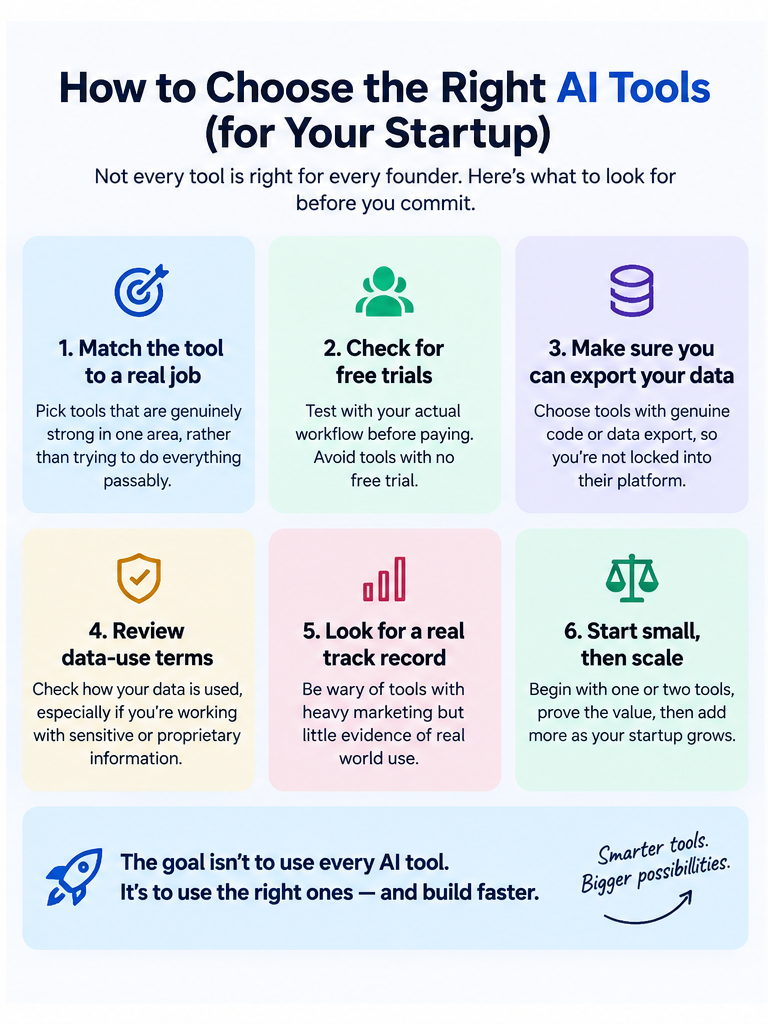
Before committing budget or workflow to any AI tool, three questions are worth asking. First, what happens to your data: read the terms on how prompts, documents or code you input are used and stored, particularly for anything involving customer data, financial information or unreleased product plans — treat vague or absent data-use terms as a real red flag, not a technicality. Second, how locked in are you: prioritise tools offering genuine code export or data portability over closed platforms that host everything on their own infrastructure with no meaningful way to leave, since real, material differences in portability exist between AI app builders that look similar on the surface. Third, hype versus demonstrated value: a slick demo is not evidence of production reliability — look for a genuine free tier or trial you can test against your actual workflow, independent reviews rather than only the vendor’s own case studies, and be wary of tools charging premium prices with no way to try before committing.
Frequently asked questions
What AI tools should a startup founder use?
Are free AI tools good enough?
Can AI build my app?
Is it safe to put company data into AI tools?
What's the best AI tool for marketing?
Which AI coding tools are worth it?
How do I avoid wasting money on AI tools?
Do AI tools own the content they create?
Building an AI app? Talk to us
If you’re weighing up whether to prototype with a no-code AI builder or invest in a custom-built product from the outset, get in touch with Nordstone — we’ll give you an honest steer on which route fits your stage and budget.