June 26th, 2026 at 09:41 am
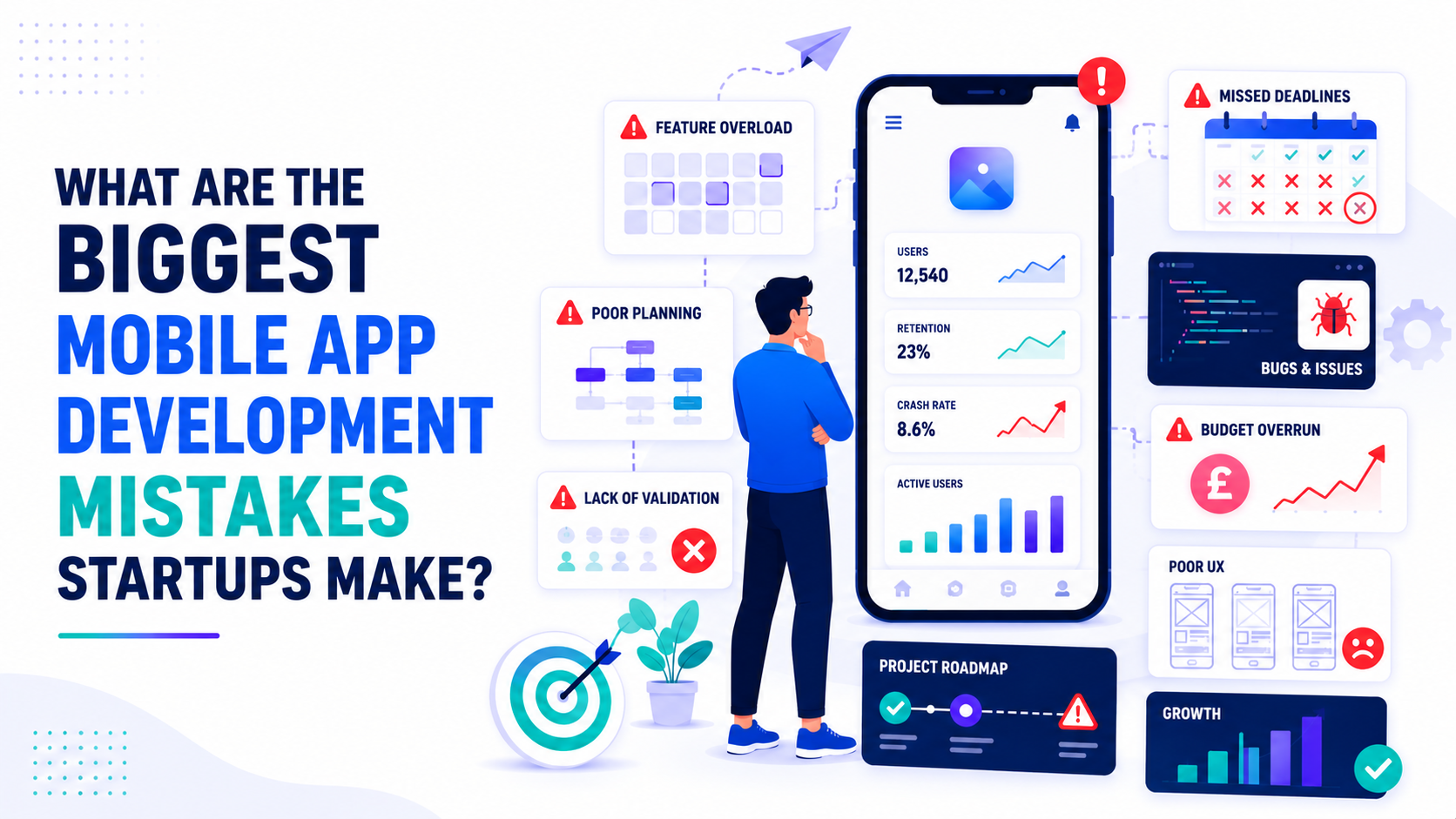
Startups rarely fail because their idea was completely wrong. More often, they fail because they make avoidable decisions during validation, planning, design, development, launch, or post-launch growth, and those mistakes compound quickly.
The strongest startup app strategies do three things well: they validate the problem before building, they keep version one focused, and they treat launch as the start of learning rather than the finish line. In a crowded app market, that discipline matters more than ever.
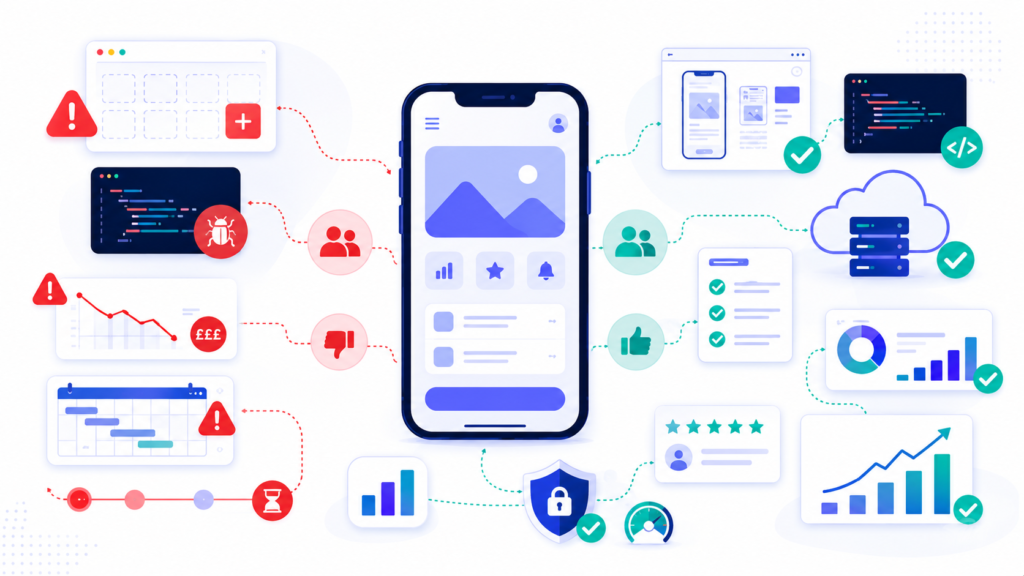
Key mistakes every startup should avoid
Mistake 1: Building the app before validating the problem
The first and biggest mistake is building before proving that the problem is real. CB Insights’ updated analysis of 431 VC-backed startups that shut down since 2023 found that the top root causes were poor product-market fit at 43%, bad timing at 29%, and unsustainable unit economics at 19%, while 70% ran out of capital as a final symptom rather than the root cause.
That statistic matters because it shows how quickly capital disappears when a product solves the wrong problem. CB Insights also reports a median of 22 months from the last fundraise to death, which makes early validation a runway issue, not just a product issue.
This mistake usually looks like founder assumptions replacing user evidence. Teams skip user interviews, ignore competitor behavior, confuse interest with intent to pay, or start development before testing demand with a landing page, waitlist, concierge MVP, or clickable prototype.
The fix is simple in principle, though not always easy in practice: pressure-test the idea before writing code. Talk to users, study how they solve the problem today, and verify that the pain is frequent, urgent, and worth paying to solve.
Mistake 2: Trying to build everything in version one
The second mistake is feature overload. Startups often treat the first release like the final product, which leads to bloated scope, longer timelines, rising costs, and a team that loses focus on the core user outcome.
The better approach is a disciplined MVP. Monzo is a strong example: it launched in 2015 with a prepaid Mastercard and app first, rather than waiting for a full banking licence, and reportedly had around 600,000 customers before the full licence arrived in April 2017. By 16 May 2017, over £250m had been spent through the prepaid card.
That kind of phased rollout is exactly what many startups need. The Standish CHAOS data is often cited to show how hard software delivery is: only around 31% of projects succeed, 50% are challenged, and 19% fail outright.
The lesson is not “build less for the sake of it.” The lesson is to build the smallest version that still creates a meaningful user outcome, then expand based on real usage.
Mistake 3: Ignoring UX and confusing onboarding
Poor user experience can kill a startup app even when the underlying idea is strong. Appcues cites research showing that 25% of users open an app once and then abandon it completely, which makes the first session critical.
The problem is usually not just visual design. Confusing onboarding, too many steps, overloaded screens, weak labels, and sign-up friction all cause early drop-off before users reach the app’s real value.
UXCam’s benchmark data also suggests typical mobile apps lose around 77% of daily active users within the first three days after install, which shows how fast interest turns into churn when the experience feels hard.
Nielsen Norman Group’s advice is especially useful here: avoid creating onboarding whenever possible and spend resources making the UI more usable instead. Their research also found that tutorials generally did not improve task performance, which is a strong argument for designing products that teach themselves through use.
Monzo works well as a positive example here too, because its early app focused on immediate value such as real-time balance updates and peer-to-peer payments rather than a dense, over-explained experience.
Mistake 4: Underestimating cost, timeline, and complexity
Many startup budgets fail because founders only budget for the build, not for the full product lifecycle. App development also includes architecture decisions, integrations, infrastructure, QA, app store compliance, security, maintenance, and post-launch iteration.
The cost side can escalate quickly when scope is unrealistic. One commonly cited CHAOS figure says that over half of projects ran 189% over the original cost estimate, which is a strong reminder to plan for contingency.
For UK pricing context, one guide places a simple single-platform app or MVP at £10,000 to £30,000, a standard business app at £30,000 to £80,000, and a complex multi-role product at £70,000 to £150,000. Other UK guides also place MVP work around £15,000 to £40,000 and enterprise-level builds at £100,000+, depending on complexity.
The practical takeaway is to budget in layers: discovery, design and development, testing and launch preparation, post-launch support, and growth updates. That way, the quote becomes a plan, not a surprise.
Mistake 5: Choosing the wrong development approach
Not every startup should build native iOS and Android apps first, and not every product should start with. Flutter or React Native. The mistake happens when founders choose the stack before they define the product requirements.
The development approach should match the product, not the trend. One cited 2024 Stack Overflow survey summary says Flutter had 46% adoption among cross-platform frameworks versus 35% for React Native, while another summary notes 9.4% of developers using Flutter in production compared with 8.4% for React Native.
Those figures should not be read as a universal recommendation. They simply show that framework popularity is not the same thing as product fit, and the right choice depends on performance needs, device-specific features, launch speed, and long-term maintainability.
A good partner will help you make that trade-off honestly. If an app needs real-time performance, heavy device integration, or highly sensitive flows, native may be the better route; if speed and budget matter more, cross-platform can make sense and may save 25% to 40% versus separate native builds.
Mistake 6: Treating testing as a late-stage box-ticking exercise
Testing should begin early, not at the end. Teams that leave QA until the final week often discover problems too late, especially around onboarding, payments, permissions, crashes, performance, and device fragmentation.
The widely cited IBM figure suggests that a bug fixed in production can cost up to 100 times more than one caught at the requirements stage, though that claim should be treated carefully because the original study is disputed. The important point is still valid: earlier detection is cheaper than late-stage repair.
NowSecure’s mobile security work also found that 24.7% of mobile apps include at least one high-risk security flaw, which shows how common serious issues are in real-world apps.
The fix is to test throughout the build: functional testing, usability testing, performance testing, security testing, and real-device testing across the screen sizes and OS versions that matter to your audience.
Mistake 7: Forgetting that launch is the beginning
A launch is not the finish line. It is the point where real user behavior starts telling you what works, what confuses people, what gets ignored, and what needs improvement.
Retention benchmarks make this very clear. Phiture’s compiled benchmarks suggest cross-industry averages around 25% to 26% on Day 1, 11% to 13% on Day 7, and 5% to 7% on Day 30, while UXCam says the median Day-30 retention across categories is around 4%.
That steep curve means a startup should expect to iterate immediately after launch. Analytics, feedback loops, bug fixes, and roadmap prioritization should all be in place before the first public release.
Monzo is again a useful example because it did not stop at launch; it kept expanding into current accounts, Pots, lending, and business accounts after the initial product proved demand.
Mistake 8: Overlooking app marketing and distribution
A good app with no distribution plan is still a weak launch. The app stores are crowded, and visibility is not automatic just because a product is live.
As of mid-2024, there were roughly 2.3 million apps on Google Play and about 1.8 million on the Apple App Store, which shows how hard discovery has become. Google also requires new personal-developer accounts to test a new app with at least 20 real users for 2 weeks before public launch.
That means app store optimisation, landing pages, launch messaging, and retention loops are not optional extras. They are part of the product strategy.
Startups should define the launch audience early, build acquisition channels alongside development, and prepare onboarding content before the app goes live.
Mistake 9: Neglecting security, privacy, and compliance
Security and privacy cannot be left until later, especially for apps that handle payments, personal data, healthcare data, AI features, or account-based services. If users do not trust the product, growth becomes irrelevant.
NowSecure reported that 95% of mobile apps fail at least one OWASP MASVS category, which is a serious warning sign for startup teams that treat security as an afterthought.
In the UK, the stakes are even clearer because the maximum UK GDPR fine is the higher of £17.5 million or 4% of total worldwide annual turnover. That makes privacy-by-design a business requirement, not just a legal one.
The Capita enforcement action is a useful warning example because the ICO fined Capita £14 million in 2025 after a breach that affected more than 6.6 million individuals. That is the kind of consequence startups should avoid by building security and compliance in from day one.
Mistake 10: Hiring the wrong development partner
Even a strong idea can suffer if the startup chooses the wrong partner or manages the right one badly. Price alone is not a reliable decision rule, and vague requirements often create expensive misunderstandings later.
UK agency rate bands can help founders’ sanity-check quotes. One guide cites Apadmi at £90 to £135 per hour, Waracle at £80 to £120 per hour, and typical London agency rates around £100 to £150 per hour, with full-feature project budgets often ranging from £60k to £150k+.
The right partner should challenge weak assumptions, define scope clearly, and think in terms of product outcomes rather than ticket completion. That matters as much as technical skill.
If a quote is far below market, the likely risk is thin discovery, weak QA, or hidden costs later. If it is far above market, the startup should ask exactly what is included and whether the project is being over-scoped.
FAQ-Biggest Mobile Development Mistakes
What is the biggest mobile app development mistake startups make?
The biggest mistake is building before validating demand. If a startup invests in development without proving that users actually want the product, it risks spending heavily on the wrong solution.
Why do startup mobile apps fail after launch?
Many startup apps fail because of weak product validation, poor UX, feature overload, inadequate testing, unrealistic budgets, and a lack of post-launch iteration. Failure is usually caused by several avoidable mistakes stacking up rather than one single issue.
Should startups build an MVP before a full mobile app?
In most cases, yes. An MVP helps validate demand, reduce risk, gather user feedback, and avoid overbuilding too early. It lets the team focus on the core value proposition before expanding the feature set.
How can startups avoid overspending on app development?
Startups can reduce overspending by defining a clear scope, prioritising essential features, validating the idea early, budgeting for post-launch work, and choosing a partner that gives realistic planning instead of vague estimates.
How important is UX in startup app development?
It is critical. Poor UX can destroy onboarding, conversion, and retention even if the underlying idea is strong. A startup app must be intuitive, fast, and easy to use from the first session if it wants users to return.
Why is onboarding such a sensitive part of mobile apps?
Because many users abandon apps almost immediately. The one-and-done problem and the steep early churn curve mean the first session often decides whether the product gets a second chance.
What should startups do after launching their app?
After launch, startups should monitor analytics, collect user feedback, fix bugs quickly, improve onboarding, refine features based on behavior, and continue optimizing retention. Launch is the start of the product improvement cycle.
How do startups choose the right development partner?
They should look for clear discovery, realistic scope, strong QA, relevant product experience, and honest communication. The best partner is the one who can help shape the product, not just code it.
Final thought
The biggest mobile app development mistakes are usually not dramatic in isolation. They are small planning errors, rushed decisions, weak assumptions, and missing systems that quietly compound until the product stalls.
The startups that do well are the ones that validate early, scope carefully, test continuously, design for real users, and build a post-launch plan before launch day arrives.
Talk to Nordstone about your mobile app project.