June 29th, 2026 at 06:43 am
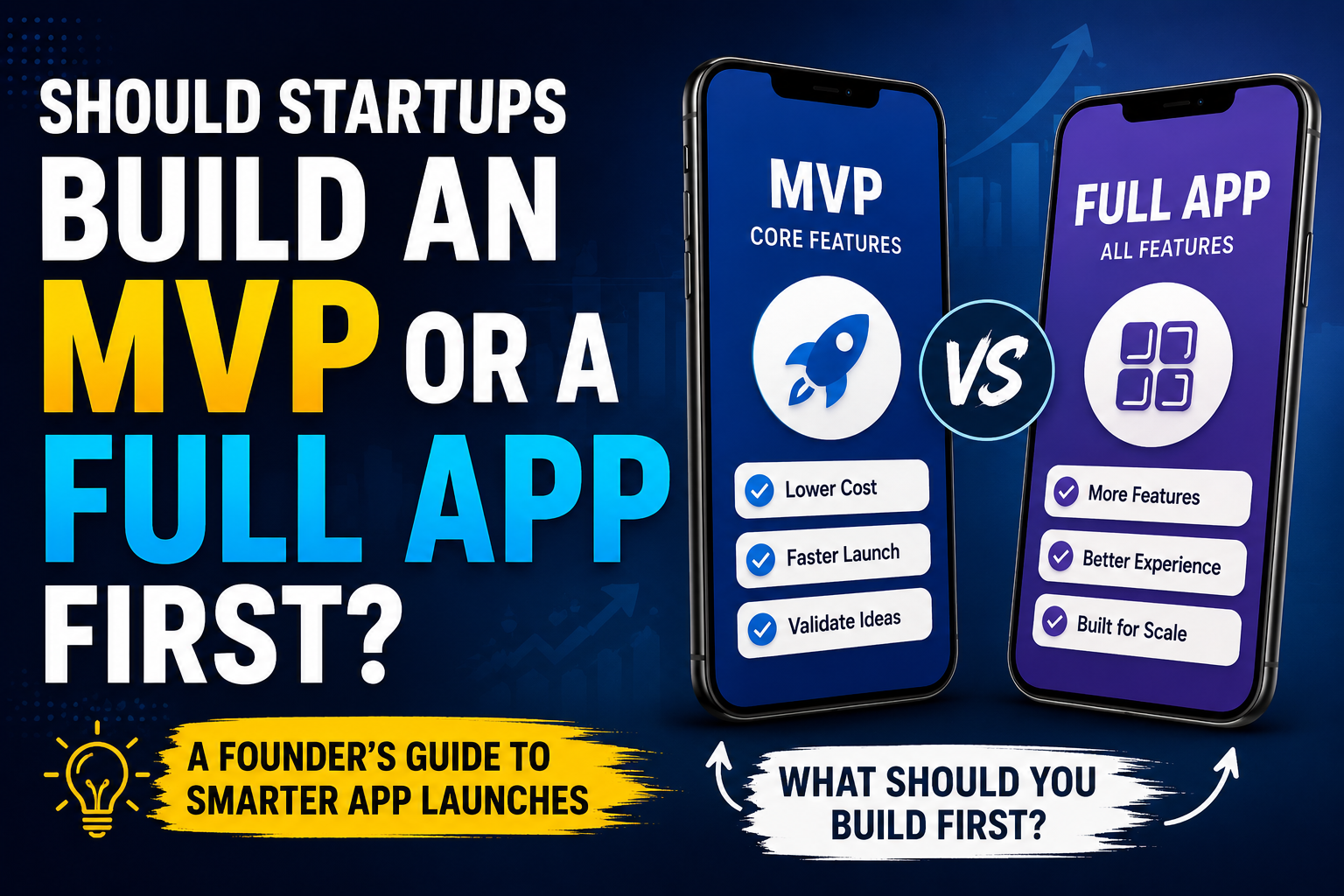
Most startups should build an MVP first, not a full mobile app, because the main risk is usually demand, not engineering. CB Insights reports that 42% of startup failures come from no market need, while its 2024 update puts that figure at 43%; in the UK, Beauhurst found that only about 23% of a 2017 high-growth cohort scaled beyond seed within five years, while 54% stagnated and 20% failed.
That matters even more in a tighter funding market. UK startups raised £16.2 billion in 2024, the lowest amount since 2020, even though the UK remained Europe’s largest venture hub, so founders have stronger reasons to validate early and spend carefully.
Eric Ries’ classic definition still applies: “The minimum viable product is that version of a new product which allows a team to collect the maximum amount of validated learning about customers with the least effort.” Ries also warns that an MVP is not about creating minimal products; the goal is learning, not shipping something broken.
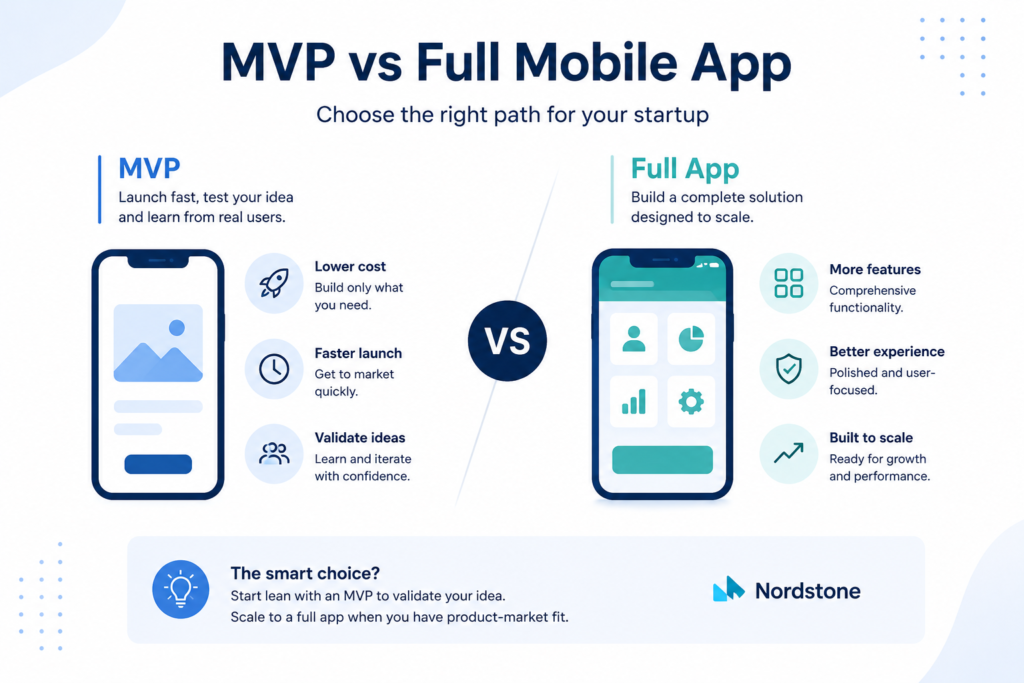
MVP vs Full Build at a Glance
Startups build an MVP or Mobile app
| Factor | MVP | Full mobile app |
| Typical UK cost | £10,000–£30,000 for a simple app/MVP; DITS cites £15,000–£40,000 for MVP builds. A common framing is that an MVP can reduce day-one spend by 40% to 60% versus a full build. | £80,000–£150,000+ for complex multi-role products; enterprise builds can reach £200,000–£300,000+. Appsierra also cites Waracle pricing in the £100,000–£200,000 range for medium enterprise solutions and £500,000–£800,000+ for large multi-year partnerships. |
| Timeline | Around 8–12 weeks for a simple app or single-workflow MVP. | Around 6–18 months for mid-size business apps and enterprise solutions. |
| Best use case | Fast validation, narrow workflow, early customer learning, and investor proof. | Complex products with multiple user roles, deep integrations, compliance requirements, or scaling commitments. |
| Main risk | Too small if it skips the core value proposition or ignores compliance. | Overbuilding before product-market fit and burning capital too early. |
What the Data Says
The evidence points to one simple rule: if you have not yet proven demand, do not spend as if demand is already certain. The UK startup funnel data from Beauhurst shows how hard it is to move from seed to scale, and CB Insights shows that market need remains the leading reason startups fail.
A lean build is not only cheaper; it also shortens the time between an idea and a real customer signal. In practice, that means a startup can test positioning, onboarding, pricing, and retention before committing to a larger engineering roadmap.
When an MVP Works Best
An MVP is the right first move when the core question is still, “Will people use this?” That is common in early-stage B2C apps, niche SaaS tools, marketplace products, and new consumer workflows. If the product can be reduced to one meaningful job-to-be-done, the MVP gives you a faster answer at lower cost.
The best MVPs are narrow, not shallow. They should still feel useful, but they should avoid unnecessary feature layers, multiple user roles, and expensive edge-case logic until the business case is proven.
MVPs That Worked
- Monzo began with a prepaid-card-led, app-first model before expanding into a full bank; that progression is a classic example of validating demand before broadening the product.
- Citymapper started with one clear problem — navigating London buses — and later expanded into a much broader urban transit product.
- Revolut also followed a leaner path, using an FX/prepaid-card entry point before becoming a wider financial superapp.
When a Full Build Makes Sense
Some products should not be treated as “move fast and break things.” If the product depends on multiple regulated workflows, high-trust transactions, or deep third-party integrations, the minimum viable version still needs a strong technical and compliance baseline.
In UK fintech and healthtech, “minimum” does not mean “unfinished.” For NHS-facing digital health products, DCB0129 and DCB0160 assurance are mandatory, and DTAC applies as an additional procurement gate.
That means the better question is often not “MVP or full app?” but “What is the smallest build that is still credible, compliant, and safe enough to test?”
Cautionary Overbuilds
- Quibi is the clearest reminder that a large launch budget cannot compensate for the wrong market fit; the company raised $1.75 billion before launch and shut down about six months later.
- Powa Technologies is a UK warning case: it was once valued at $2.7 billion, raised $225 million, and then collapsed into administration after heavy losses.
- Babylon Health shows the danger of expanding too broadly too early; it peaked at a $4.2 billion valuation in 2021, then collapsed in 2023 after major losses and operational strain.
A Practical Decision Framework
- Choose an MVP first if you are still testing the core use case, the audience, or the pricing model.
- Choose a fuller build first if the product must satisfy enterprise buyers, regulated workflows, or multi-role permissions from day one.
- Use a staged roadmap if you need both: launch the smallest compliant product, then add features only after there is evidence of demand.
A startup should budget for learning as well as building. The MVP route is attractive not because it is “cheap,” but because it lowers the cost of being wrong.
If you already know the product has enterprise complexity, then the extra spend on architecture, security, and integration can save money later by reducing rewrites and compliance risk.
FAQ
What is an MVP?
An MVP is the smallest version of a product that is good enough to learn from real users, not a deliberately broken product. Eric Ries defines it as the version that lets a team collect the maximum amount of validated learning with the least effort.
How much does a startup MVP cost in the UK?
Typical UK MVP ranges in the sources you supplied are £10,000–£30,000 and £15,000–£40,000, depending on scope and complexity.
How long does an MVP take to build?
A simple MVP can ship in about 8–12 weeks, while larger business or enterprise apps can take 6–18 months.
When should a startup skip the MVP approach?
When the product is highly regulated, depends on complex integrations, or must satisfy enterprise expectations from day one, the minimum viable build still needs a strong compliance and reliability floor.
Turn Your App Idea into Reality
For most startups, the smartest move is to validate first and scale second. An MVP helps you test the real market need, control upfront costs, and avoid spending months building features that users may never value.
If you are still deciding whether your startup needs an MVP or a full mobile app, Nordstone can help you define the right scope, timeline, and launch plan. To discuss your project, visit the Contact Us page and get in touch with the team.
You can also explore Nordstone’s services to see how the right product strategy can reduce risk and speed up delivery.