July 3rd, 2026 at 04:32 am
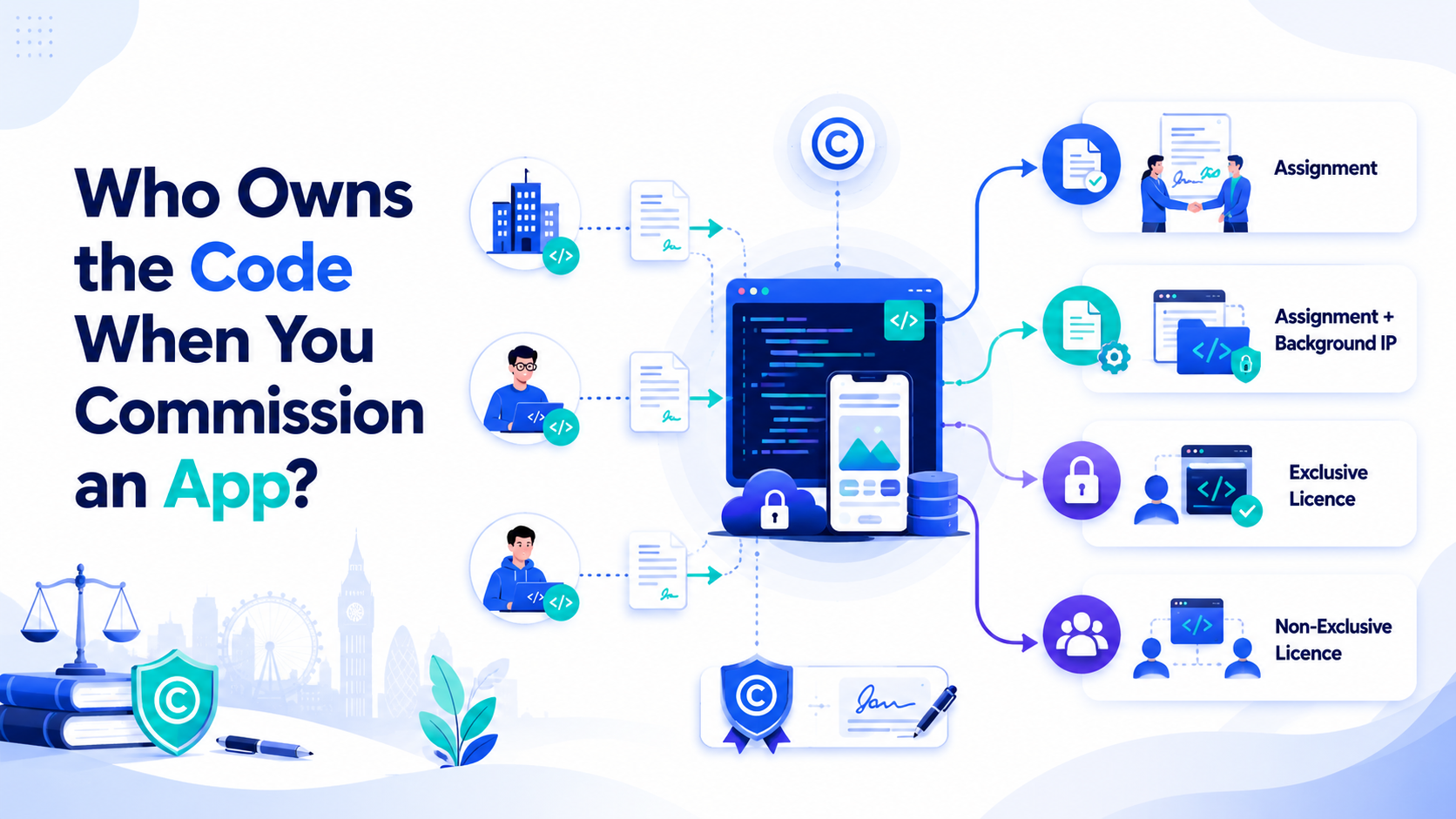
If you hire an agency or freelancer to build your app, you usually do not own the code by default. Under UK law, the agency or contractor normally owns copyright in the software unless those rights are assigned to you in writing.
- Employee-written code usually belongs to the employer under section 11 of the CDPA 1988.
- Agency- or contractor-written code usually belongs to the developer unless assigned in writing.
- A license is not ownership; it only permits the use the software on stated terms.
- The safest contract wording uses a present-tense assignment, not a vague promise to assign later.
The UK default: who owns app code?
The starting point is section 11 of the Copyright, Designs and Patents Act 1988. It says the author is the first owner of copyright, except where a work is made by an employee in the course of employment, in which case the employer is usually the first owner unless the parties agree otherwise.
That distinction is what catches many founders out. If an in-house employee writes the code, your company will usually own it. If an outside agency, consultant, or freelancer writes it, they will usually own it unless the contract transfers the rights to you in writing.
The leading UK authority often cited on commissioned works is Robin Ray v Classic FM plc FSR 622. It is regularly relied on for the principle that paying for a commissioned work does not automatically transfer copyright to the customer.
What that means in practice
A founder can pay for a bespoke app and still not own the codebase. Without a written assignment, the supplier may only be licensing the app back to you, which can limit your ability to move to a new developer, sell the business cleanly, or prove title during fundraising.
This becomes a real commercial problem when a relationship breaks down or due diligence begins. Investors typically want to see a clean chain of title from every contributor into the company, especially where software is core to the business.
The four IP ownership scenarios
| Scenario | What it means | Commercial impact |
| Full written assignment | Supplier transfers copyright in agreed deliverables to you | Best position for diligence and supplier changes |
| Assignment with background-IP carve-outs | You own bespoke deliverables, supplier keeps pre-existing tools and libraries | Common and workable if carve-outs are narrow. |
| Exclusive perpetual licence | You get broad long-term rights, but ownership stays with the supplier | May still worry investors |
| Non-exclusive licence | Supplier owns code and can retain broad reuse rights | Highest risk for a product business |
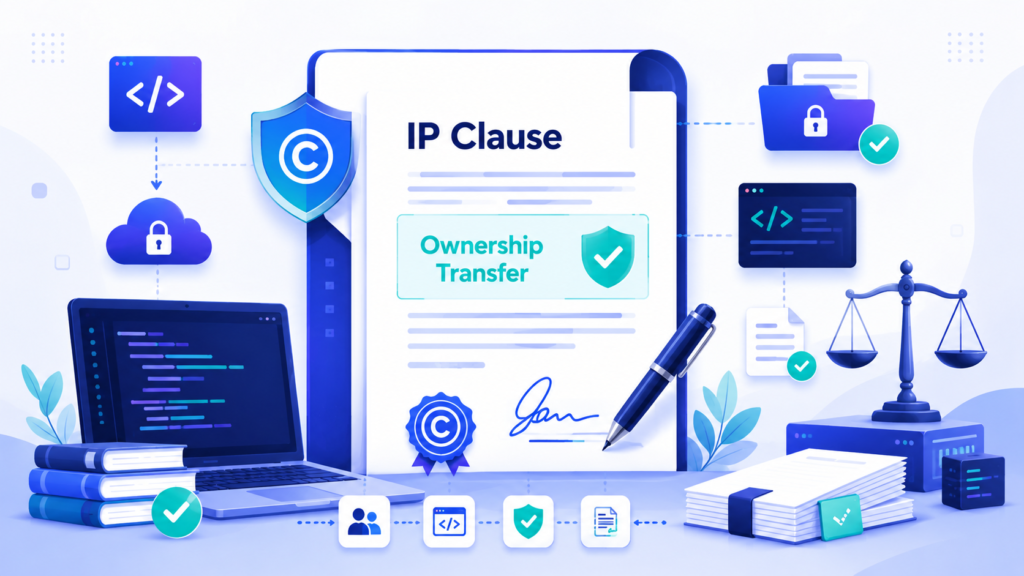
A well-drafted IP assignment clause helps establish clear ownership of software code and related intellectual property.
1) Full written assignment
This is what most buyers think they are purchasing. A proper assignment transfers ownership of copyright in the agreed code, documentation, designs, and related deliverables to the client in writing.
2) Assignment with background-IP carve-outs
This is often the most realistic arrangement. The client owns the bespoke output, but the supplier keeps ownership of its pre-existing frameworks, generic libraries, deployment scripts, and know-how, while granting the client a licence to use them where needed.
3) Exclusive perpetual licence
This can look close to ownership because the client may have long-term, exclusive use rights. Legally, though, it is still a licence, not an assignment, and that can matter during investment, exit, or supplier migration.
4) Non-exclusive licence
This is the weakest outcome for a bespoke app. The client can use the software, but the supplier keeps ownership and may keep broad freedom to reuse or resell parts of the codebase.
“Hereby assigns” vs “agrees to assign”
This wording matters more than many buyers realise. A clause saying the developer hereby assigns rights is generally treated as a present transfer. A clause saying the developer agrees to assign rights later may leave a gap if follow-up paperwork was expected but never signed.
That gap can become painful at fundraising. If investor counsel sees only a promise to assign in the future, they may ask for deeds of assignment from old contractors before the round can close smoothly.
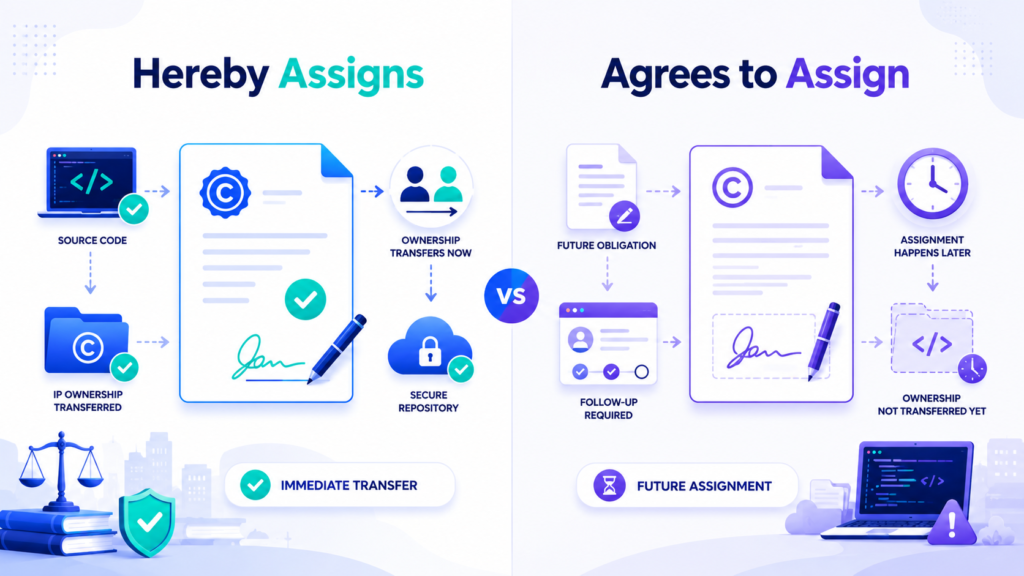
Compare immediate and future intellectual property assignment clauses in software development contracts.
Sample clause language
Hidden IP pitfalls founders miss
Open-source software
You do not “own” open-source components in your app. You use them under their licences, and the compliance burden depends on the licence family. Permissive licences such as MIT and Apache 2.0 are usually more straightforward than GPL-style licences, which can create broader obligations in some circumstances.
Third-party SDKs and tools
Payments, maps, analytics, push notifications, and cloud services often run under third-party licence terms and account ownership. If your agency controls the accounts, keys, or billing, you may have less control than you think at handover.
Background IP carve-outs
A background-IP clause is normal, but it must be tightly defined. If it is too broad, your supplier may retain ownership of core modules, scripts, or architecture that your app cannot function without.
AI-generated code
But the wider UK policy position is still evolving. The government consultation on copyright and AI launched in December 2024 and closed in February 2025, which shows the legal and policy debate is still active.
What investors and acquirers look for?
At Series A, counsel will usually want clean evidence that your company owns or validly controls its core software assets. That means signed assignments from founders, employees, agencies, and contractors, plus clear repository access and a record of what third-party code sits in the stack.
A common horror story is simple: the founder assumes the company owns the app, then finds out the repository sits in the agency account, one contractor never signed an assignment, and the contract only grants a limited licence. That can delay a deal and weaken the company’s bargaining position.
If your supplier handles personal data on your behalf, there is also a separate contracting issue. Article 28 UK GDPR requires processing by a processor to be governed by a written contract containing specified terms.
What to demand in your app development contract
Before you sign, ask for these points explicitly:
- Present-tense IP assignment of all agreed deliverables.
- A clear definition of background IP and a perpetual licence to any retained components you need to use, maintain, modify, and migrate the app.
- Repository access from day one, not only at “handover.”
- Open-source disclosure and confirmation of licence compliance.
- A schedule for third-party SDKs, tools, and account ownership.
- A moral-rights waiver where appropriate under UK law.
- Source code escrow for business-critical systems; UK providers such as NCC Group offer escrow and verification services.
FAQ
Do I automatically own the code my agency writes?
No. In the UK, agency- or contractor-written code is usually owned by the developer unless it is assigned to you in writing.
What is the difference between an assignment and a licence?
Assignment transfers ownership. A licence only permits you to use the IP on agreed terms.
Can I take my code to another developer mid-build?
Only if your contract gives you the ownership or portability rights to do so and you have access to the repository, assets, and credentials.
What is background IP?
It usually means the supplier’s pre-existing tools, templates, libraries, and know-how. Yes, you should worry about it, because a broad carve-out can reduce the value of your “ownership.”
Who owns AI-generated code in the UK?
There is no simple answer yet. Section 9(3) CDPA still applies to computer-generated works, but AI policy is under active review in the UK.
Do I own open-source components in my app?
No. You generally use them under their own licence terms rather than owning them outright.
What if my agency goes bust?
You may lose practical access unless you already have repository control or an escrow arrangement in place.
How do I prove I own my app?
The best evidence is a signed assignment deed or development agreement, plus repository records, contributor mapping, and an audit of OSS and third-party dependencies.
What Founders Should Remember
Under UK law, you usually do not own app code just because you paid for the build. If an outside agency or contractor did the work, ownership must be assigned in writing, and the contract should clearly cover source code, background IP, open-source use, and repo access.
Get a free IP/code-ownership review of your existing app contract.